
|
On a single exposure of a few minutes duration, a typical KBO appears as a faint point source. They can be distinguished from background stars by detecting their apparent motion relative to the distant scene of stars and galaxies. This motion which is largely a reflex motion due to the Earth's orbital motion and typically has a rate between 1.5 and 3 arcsec per hour for objects at distances between 30 and 50 AU. Ordinarily, KBOs have apparent magnitudes fainter than R=20 with the number per square degree increasing rapidly as the magnitude increases. In our program, we take 4-minute exposures through a broad VR filter covering as many fields as possible per night with each field visited twice at a separations between exposures of approximately 2 hours. We use 2x2 on-chip binning in order to reduce read out time and data volume. | 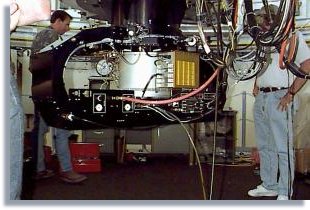
NOAO's Mosaic wide field optical imager mounted on
the KPNO 0.9-meter telescope. The Deep Ecliptic Survey is being conducted
with the Mosaic Cameras on the 4-meter Mayall
and Blanco telescopes at Kitt Peak National Observatory (KPNO) and
Cerro Tololo InterAmerican
Observatory (CTIO), respectively. |